We tend to think about ageing in terms of birthdays, and aesthetic medicine often follows the same habit. “What should I start doing after 30?” “Which treatment should I do at 40?” “What is the best anti-ageing procedure after 50?”
There is a problem with this approach. Skin does not read the calendar. I can see two patients of the same chronological age whose skin tells two very different stories, and that is why I believe we should stop treating age as a treatment protocol.
A date of birth tells me how long someone has been alive. It does not tell me how their skin has aged. Genetics matter, and so do sun exposure, sleep, smoking and alcohol, nutrition, stress, hormonal changes, environmental exposure and skincare habits. All of these accumulate differently from one person to the next, so two people can both be 45 on paper and need completely different approaches.
Ageing is also not one change. A common misconception is that it simply means wrinkles. Over time we may see changes in collagen, elasticity, pigmentation, texture, hydration, volume and facial contours, and they do not move at the same speed. One person develops pigmentation early but keeps good fi rmness. Another has very even skin tone but starts to notice laxity. Someone else is mainly concerned about texture. So when I am asked, “What is the best anti-ageing treatment for my age?”, my answer begins with another question: what is actually ageing in your skin?
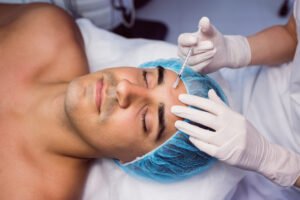
That is where assessment comes in. Modern aesthetic medicine gives us increasingly sophisticated ways to evaluate skin, but even the best technology should complement a careful clinical assessment, not replace it. I want to understand the skin in front of me: its quality, its history, its exposure, its structure, the concerns the patient has now and, where appropriate, what may be changing beneath what the mirror immediately shows. Only then does it make sense to talk about treatments. Treating a number is easy. Treating the individual takes more thought.
Starting early does not mean doing more. When people hear that healthy-ageing care should begin earlier, some imagine aggressive procedures at a younger age. That is not what I mean. Starting early can simply mean understanding the skin: protecting it from excessive sun, building sensible skincare habits, addressing pigmentation or infl ammation when necessary, looking after sleep, nutrition and general health, and intervening only when there is a genuine indication. Preventive care should not become preventive overtreatment. The aim is not to stop ageing, which would be neither realistic nor desirable. It is to age well.
I am often asked, “When should I start?” There is no single birthday on which everyone suddenly needs aesthetic treatment. For one person, the right answer may be skincare and sun protection. For another, it is pigmentation. For someone else,
collagen-supporting strategies may become relevant. And another person of exactly the same age may need nothing at all. That is why decisions based purely on age rarely make sense to me.
Aesthetic medicine has traditionally been procedure-focused: see a concern, choose a treatment, perform it. I think the future is more longitudinal. We should understand how someone’s skin is changing over years, not only how it looks during one appointment, because that allows smaller, more considered decisions along the way. Sometimes we treat, sometimes we maintain, sometimes we simply observe, and sometimes we decide that nothing needs to be done.
Ageing is inevitable, but its visible expression is remarkably individual. That is what makes treating it both challenging and interesting. So instead of asking, “What should someone my age be doing?”, we might ask, “What does my skin need at this stage?”
Your passport knows your chronological age. Your skin tells a more interesting story, and good aesthetic medicine should learn to read it.